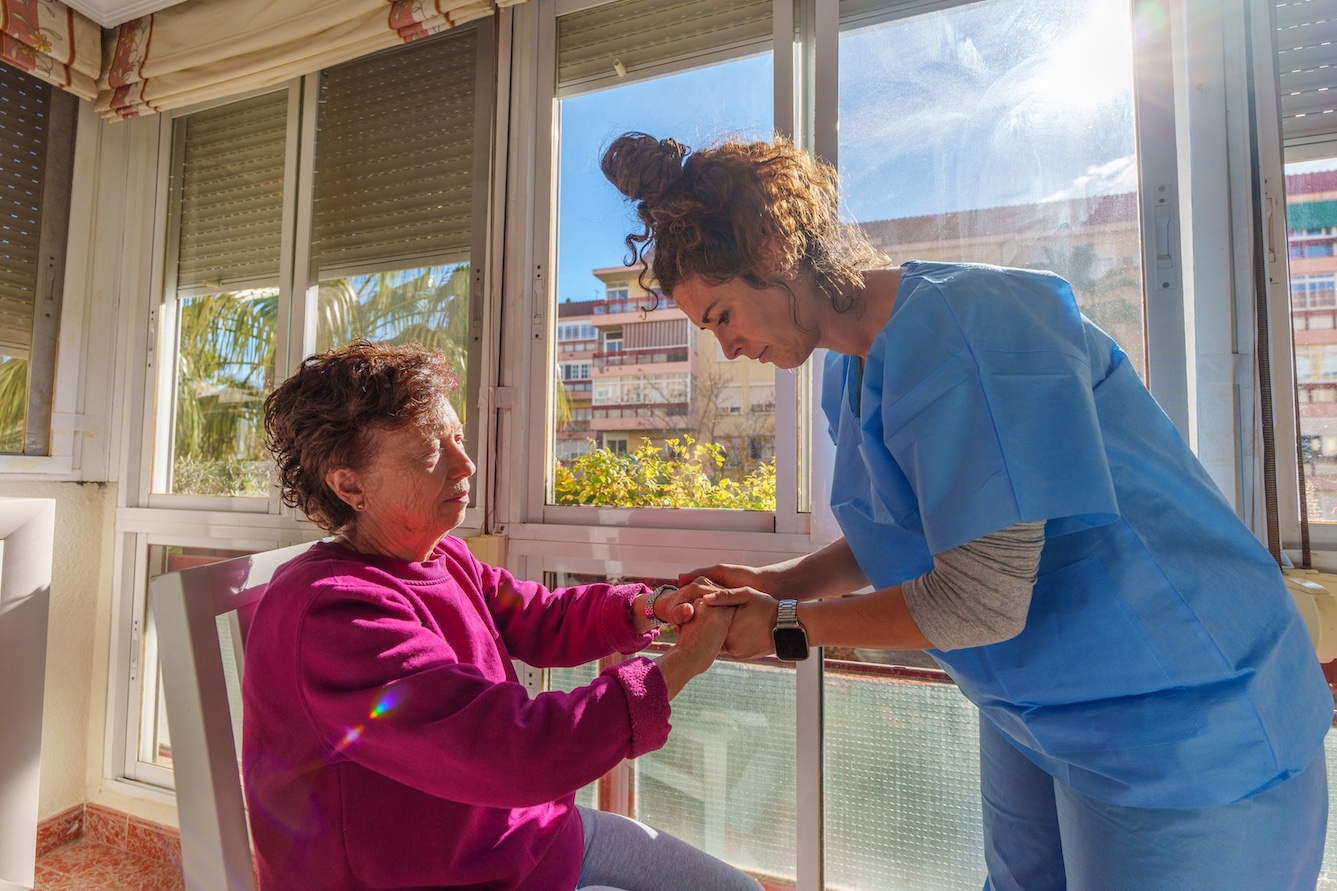
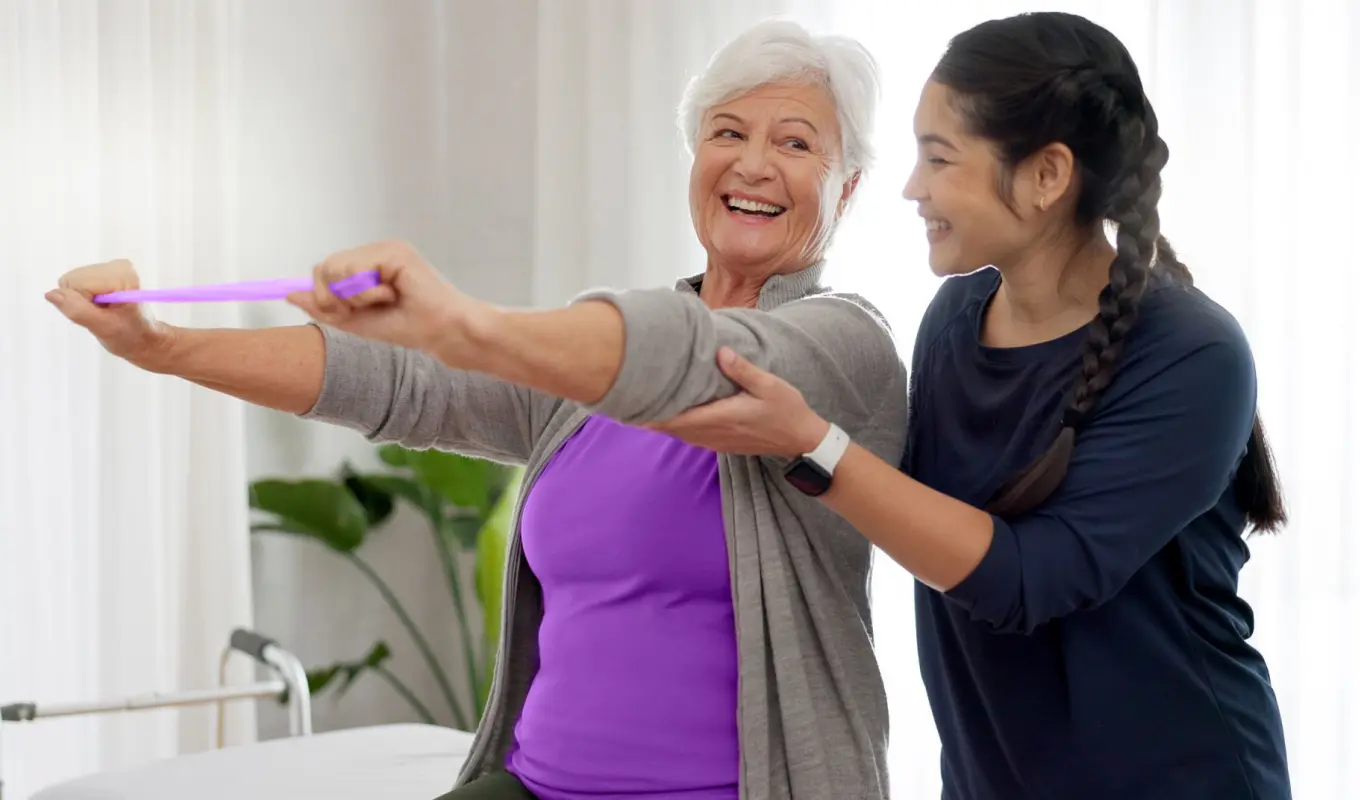
Rehabilitation research has linked a stronger therapist-patient relationship to better adherence, satisfaction, and physical function. As a Luna physical therapist, you build a trusting relationship in real time — producing positive health gains long
after a visit ends.
WHAT DOES TOP-OF-LICENSE CARE LOOK LIKE FOR CHRONIC NEUROLOGICAL CONDITIONS?
For conditions such as MS and Parkinson's, top-of-license physical therapy means combining specialized exercise, ongoing assessment, and your own clinical judgment to help people stay mobile, safe, and independent.
You adjust exercise as symptoms change, address gait and balance, reduce fall risk, recommend equipment or home modifications, and coordinate with other providers when needed. In-home care adds a critical ingredient: you can see, treat, and measure how
your patient actually moves through daily life.
A review of 30 randomized trials involving more than 2,200 people with Parkinson's found that home-based exercise improved motor symptoms, walking speed, balance, dexterity and quality of life.
CARE BUILT WITH THE PATIENT
In a Luna patient's home, you go beyond cookie-cutter plans. You build the care plan with them. One patient and you, watching, learning and adjusting together in real time:
A hand that doesn't quite clear the counter today.
A stride that shortens on the left.
A near-fall the patient almost didn't mention.
An exercise that has suddenly become too easy — or too hard.
That kind of shared attention builds something a rushed, episodic model of care struggles to create: a relationship that ensures real insights. The plan becomes something you build around the person rather than prescribe to them.
THE HOME IS CLINICAL DATA
For your neuro patients, the home is more than a stand-in for a clinic gym. It's where mobility, safety, confidence, and independence actually have to hold up.
Consider the numbers:
In one large analysis, 56% of people with Multiple Sclerosis (MS) experienced a fall in the previous three months.
65% of those falls happened indoors.
About 6 in 10 people with Parkinson's in a review of 22 studies experienced a fall.
Nearly 4 in 10 were recurrent fallers.
You get to see the hallway, staircase, bathroom, and kitchen where those risks actually live. Progress doesn't have to transfer from a gym to real life. It already lives there.
“Effective rehabilitation relies on establishing strong relationships,” says Luna’s AnnMarie Ciulla, PTA. “The outpatient, at-home model allows Luna clinicians to do continuous assessment and real-time clinical monitoring. At Luna, you have the autonomy
to make those judgments where they matter most: alongside your patient, in the life they're working to preserve. You recognize when a patient is not progressing along the anticipated recovery pathway. You can modify your clinical approach or revise
treatment strategies in real time to help the patient reach optimal functional outcomes.”
DIFFERENT DISEASES. INDIVIDUAL DECISIONS.
With Parkinson's, you may focus on amplitude, gait, balance, cueing, strength, and aerobic training. With MS, you may weigh a different calculus around mobility, fatigue, balance, spasticity, endurance and energy conservation.
In both, top-of-license care means you're continually deciding:
- What should we progress?
- What should we modify?
- What should we measure?
- What needs to be protected?
- What can this patient safely carry into daily life?
FATIGUE DOESN'T ALWAYS MEAN STOP
Top-of-license judgment matters especially in MS.
A review of 22 randomized trials involving 920 people with MS found that meeting established physical-activity guidelines produced clinically meaningful reductions in fatigue.
So when your patient is fatigued, that doesn't necessarily mean stop. It means dose intelligently.
That requires you to distinguish between:
- A patient who is ready to be pushed further.
- Fatigue that calls for a different strategy.
- A change in function that needs closer attention.
- A new symptom that you should share with another member of the care team.
BEFORE MOBILITY IS LOST
In the home, you can act before a risk becomes a setback. That might mean:
Moving a rug before it causes a fall.
Changing how a patient navigates a staircase.
Practicing a transfer in the actual bathroom where it must happen.
Adjusting an assistive device as mobility changes.
Helping family members recognize risks earlier.
For your patients with MS, the finding that nearly two-thirds of recorded falls in one analysis occurred indoors makes that environment especially important.
JUDGMENT IN MOTION
The most advanced part of neurological rehabilitation is often not a device or named protocol. It's knowing what comes next.
When to increase challenge. When to introduce a cue. When to change an assistive device. When to protect energy. When a new symptom needs escalation. When a patient can do more than they think. Continuity sharpens that judgment.
You know your patient's baseline, see the changes, understand the home, and can separate a bad day from a meaningful shift.
THE FULL ARC
Top-of-license practice changes more than patient outcomes. It shapes your professional story, too.
For your patient, continuity means having a therapist who knows:
- Where they started.
- What has changed.
- What independence looks like for them.
But something happens on your side of that relationship, too. As you change your patients, your patients change you.
Research into professional identity in physical therapy suggests that becoming a clinician isn't something you finish when you earn your degree. It's an ongoing process — shaped by experience, reflection, colleagues and, importantly, patients themselves.
Following someone with MS or Parkinson's over time gives you something a textbook, course or isolated episode of care cannot. You see how a disease actually behaves across good days and bad ones. You discover which cues work for which patients. You learn
when fatigue means modify and when it means keep going. You watch small clinical decisions accumulate into meaningful changes in someone's life.
The patient becomes part of your clinical education.
And that experience can change what you want from your career.
Research on physical therapists has linked meaningful, challenging work, autonomy, and opportunities for professional development to greater job satisfaction. More recent research has found that the satisfaction therapists derive specifically from helping
patients can help protect against their desire to leave their jobs.
There is something powerful in that reciprocity.
Your expertise helps a patient remain mobile, confident, and independent.
Their progress deepens your expertise.
Their trust sharpens your sense of responsibility.
Their complexity pushes you to learn more.
And seeing what increasingly sophisticated care can make possible may be what draws you deeper into neurological physical therapy in the first place.
A patient can become the reason you develop a specialty — not simply the beneficiary of it. That's a different way to think about top-of-license practice. It's not simply the opportunity to use everything you already know.
It's the opportunity to become the clinician you haven't become yet.
JOIN THE MOVEMENT
SOURCES
American Physical Therapy Association. Physical Therapist Management of Parkinson Disease: A Clinical Practice Guideline. Physical Therapy. 2022.
National Institute for Health and Care Excellence. Multiple sclerosis in adults: management. NICE Guideline NG220.
Ebersbach G, et al. Comparing exercise in Parkinson's disease — the Berlin LSVT BIG study. Movement Disorders. 2010.
Nilsagård Y, et al. Falls in people with MS: individual data meta-analysis from prospective studies. Multiple Sclerosis Journal. 2015.
Allen NE, et al. Recurrent falls in Parkinson's disease: a systematic review. Parkinson's Disease. 2013.
Systematic review and meta-analysis of home-based exercise interventions for people with Parkinson's disease.2024.
Systematic review and meta-analysis of physical activity guidelines and fatigue in multiple sclerosis. Physical Therapy. 2025.
Hall AM, et al. The influence of the therapist-patient relationship on treatment outcome in physical rehabilitation: a systematic review. Physical Therapy. 2010.